SaaS SEO Checklist for Founders (Practical, Not Agency Theory)
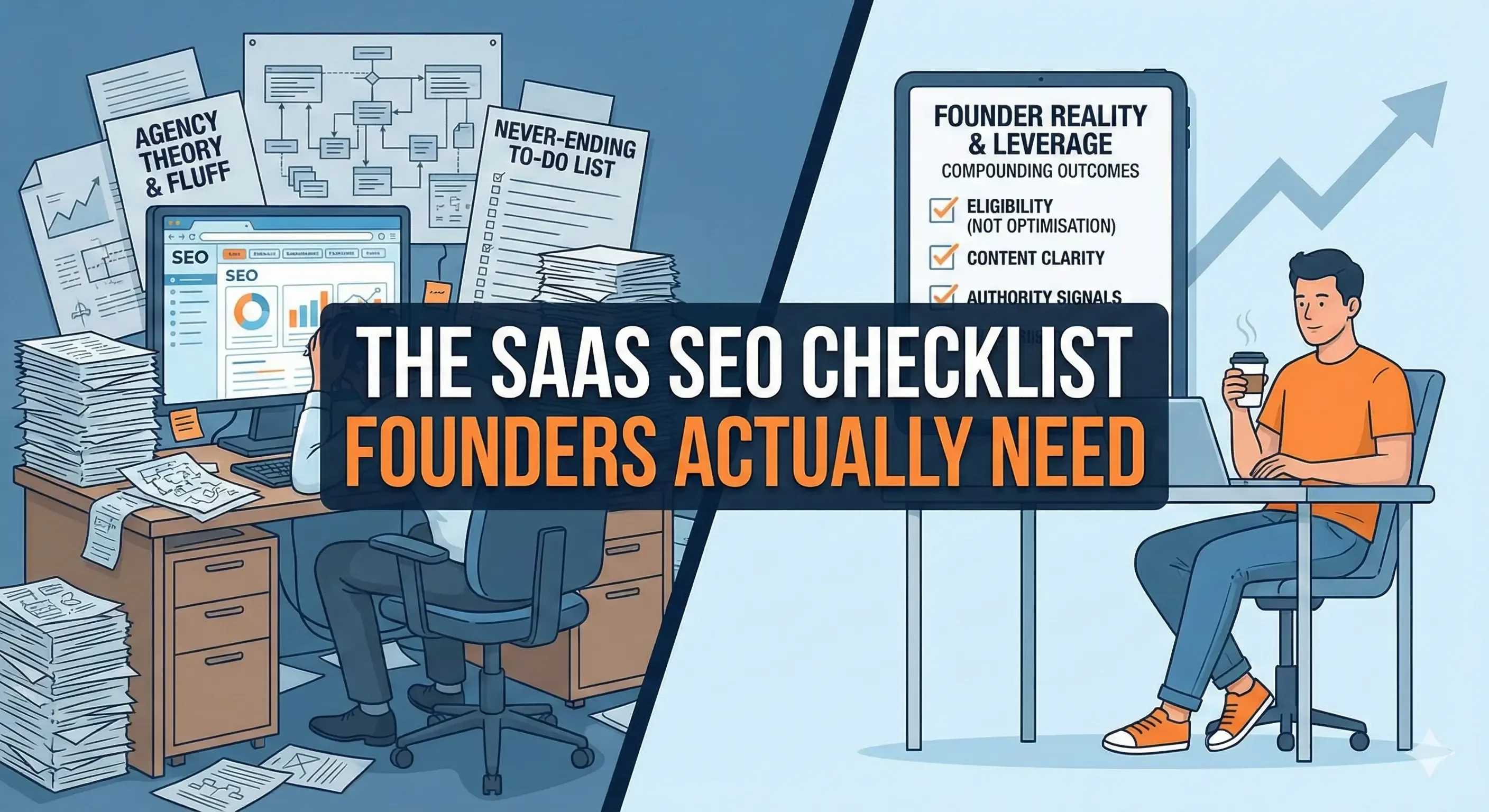
"The SaaS SEO Checklist Founders Actually Need" illustrates a busy founder versus a calm one using a streamlined SEO checklist.
The SaaS SEO Checklist Founders Actually Need (Not Agency Fluff)
“If SEO feels like a never-ending to-do list, you’re probably using the wrong checklist.”
Most SaaS SEO checklists are written by people whose job is SEO. Founders don’t live in that world. You’re balancing product, hiring, revenue, and survival. A checklist that treats every task as equally important is not just unhelpful — it’s actively dangerous.
This checklist is different. It’s designed to answer one question: what actually moves SEO forward for a SaaS company at an early stage?
What this checklist optimises for
This checklist is built around three founder realities:
- You don’t have time to learn SEO theory
- You need leverage, not perfection
- You care about compounding outcomes, not short-term wins
If you want the strategic context behind this checklist, start with SEO for SaaS founders. This article is about execution clarity.
Level 1: Technical SEO as a gatekeeper (not a growth lever)
Technical SEO rarely creates growth. But it can quietly block it.
Your goal at this stage is not optimisation. It’s eligibility.
- Your site is fully indexable (no accidental noindex, no blocked content)
- Each page has a single canonical URL
- Core pages load quickly enough to preserve user trust
- Mobile experience works end-to-end
Founder insight: Once this is “good enough”, stop touching it. Technical SEO should fade into the background.
Level 2: Content clarity (where most SaaS SEO breaks)
Search engines — and AI systems — don’t reward creativity first. They reward clarity.
Every important page should make three things obvious within seconds:
- What problem this page addresses
- Who it’s for
- Why your answer is credible
Practical checklist:
- One primary topic per page
- A clear definition or summary near the top
- Logical H2 → H3 flow that mirrors human reasoning
- FAQs that reflect how people actually phrase questions
This structure doesn’t just help Google. It improves your chances of being cited in AI-generated answers — a core idea explored in how founders should approach SEO.
Level 3: Authority signals founders consistently underestimate
Authority isn’t just backlinks. It’s coherence.
- Consistent positioning across product and content
- Internal links that reinforce topical focus
- Depth on a small number of problems instead of surface-level breadth
Search systems are increasingly asking a simple question: does this site look like it should be trusted on this topic?
What to ignore early (intentionally)
These feel actionable. They rarely change decisions.
- Daily rank tracking
- Keyword difficulty scores
- Competitor backlink obsession
So what? If a metric doesn’t change what you publish next week, it’s noise.
A simple weekly SEO cadence for founders
- Review what was published
- Check indexing and high-level performance
- Decide the next single priority
If SEO demands more attention than this, your system is broken.
CTA
Want this checklist turned into weekly decisions?
AutoZella applies this exact logic automatically — deciding what to publish, why it matters, and what to do next, without drowning you in SEO metrics.
Stay updated with AutoZella
Join our newsletter to receive the latest insights on automotive AI and SEO strategy.
Subscribe Now