The Citation Gap: Why Your SEO Strategy is Invisible to AI (and How to Fix It)
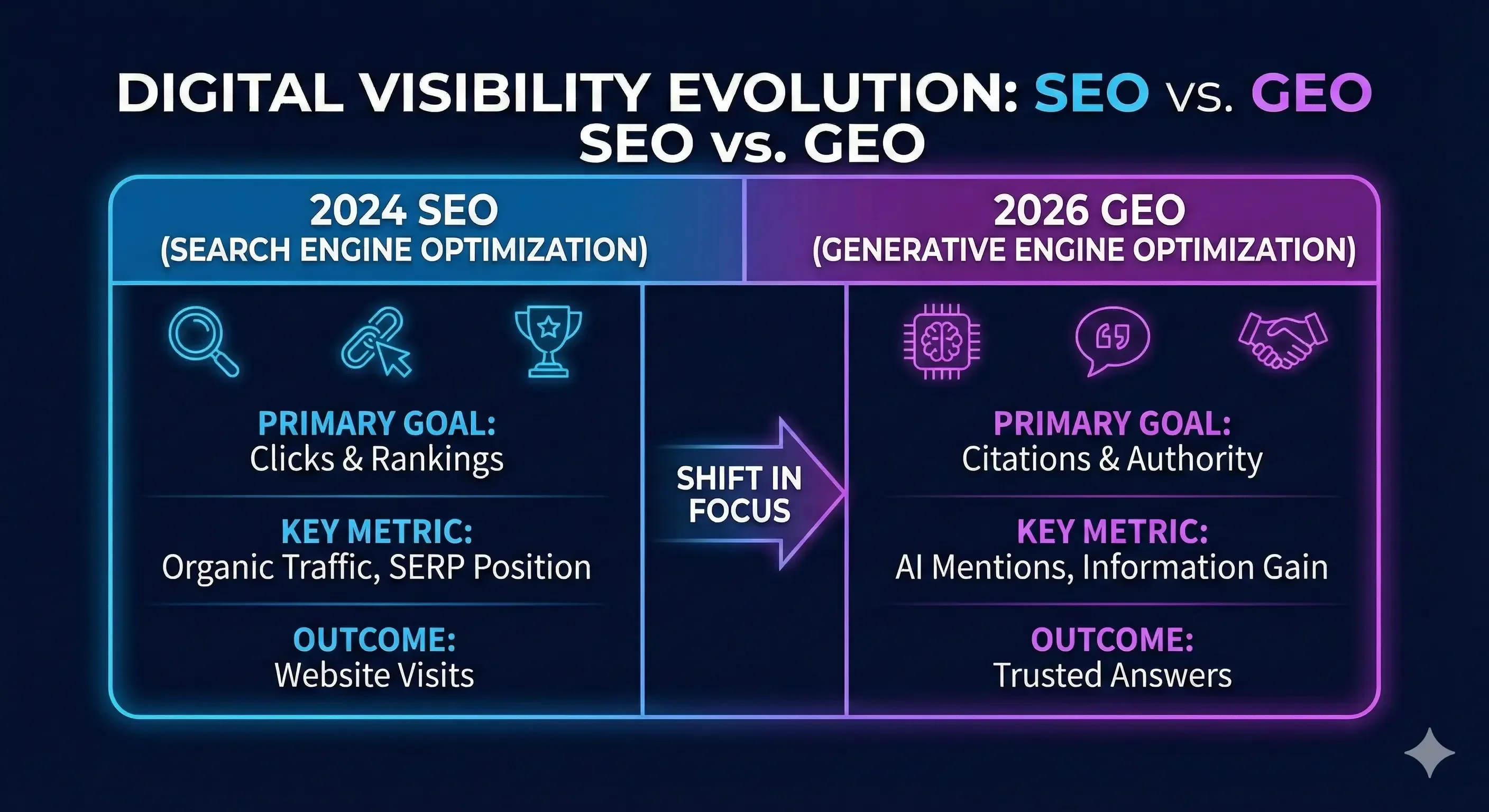
This chart compares 2024 SEO (clicks, rankings) with 2026 GEO (citations, trusted answers), showing digital visibility evolution.
The Citation Gap: Why Your SEO Strategy is Invisible to AI (and How to Fix It)
You've finally cracked it. After six months of grinding through backlinks, rewriting meta descriptions at 2am, and stuffing "best [your service] in [your city]" into every bloody paragraph, you're sitting at position #2 on Google for your main keyword.
Then someone asks ChatGPT about your industry.
The AI spits out a confident answer. Cites three sources. All your competitors. Your brand? Nowhere. Not even an honourable mention.
Welcome to the Citation Gap. You've been optimising for an algorithm that reads web pages. But you haven't optimised for an intelligence that actually understands them, synthesises them, and decides which ones are worth trusting. And if you're invisible in that generative layer, you're invisible to everyone who's stopped typing questions into Google.
Keywords Are Dead. Information Gain Is What Matters Now.
Here's the mistake: thinking ChatGPT and Perplexity are just "Google with a chatbot stuck on top."
They're not. Google looks for relevance signals—backlinks, dwell time, keyword matches. Large language models look for something else entirely: information gain. That's the unique insight you're providing that isn't already plastered across the top ten results.
Most content in your niche is derivative. It's the same advice repackaged with different header images. AI models ignore it for the same reason you'd ignore the tenth person at a party telling you the exact same story. There's no new information.
This is why we built AutoZella as what we call a "decision-first content engine." Most SEO tools vomit data at you. Keyword volume, difficulty scores, SERP features. Great. What do you actually write? They don't answer that. They tell you to use a keyword twelve times but not how to structure content so an AI can parse it, trust it, and cite it.
To bridge the Citation Gap, you need to stop thinking like a content creator and start thinking like a knowledge provider. Show your research. Reveal your methodology. Make it easy for the AI to understand not just what you're claiming, but why you're right.
The Mechanics of Getting Cited
AI citation isn't random. It's structural. If your content is a 2,000-word wall of text with no clear takeaways, the AI will skim past you every single time. These models want what I call "snackable truth"—clear, defensible claims they can extract and attribute.
The pages that get cited consistently share three traits:
First, transparent methodology. They don't just make claims; they show the research trail. "We analysed 47 tools across these six criteria" beats "These are the best tools" every time. The AI needs to see your work.
Second, structural clarity. Comparison tables. Structured FAQs. Schema markup. These act as a map for AI crawlers. They can grab a clean answer without wading through paragraphs of fluff.
Third, decision-first architecture. The best content doesn't just dump information; it helps someone make a choice. "If you need X, choose A. If you need Y, choose B." That's citeable. A rambling listicle isn't.
We've started tracking what we call "AI citation probability" in AutoZella's opportunity cards. It's a score that helps you prioritise which content has the highest chance of being quoted by generative engines. Turns out, it's not always your highest-traffic pages.
Quick test: open your top five pages right now. If you don't have at least one comparison table or structured FAQ on each, you're basically asking ChatGPT to ignore you.
SEO vs. GEO: The Shift You're Missing
There's a new layer forming on top of search, and it has different rules. We're calling it Generative Engine Optimisation, or GEO for short. Here's how the priorities have shifted:
| What Matters | Traditional SEO | GEO (Generative Engine Optimisation) |
|---|---|---|
| Your Goal | Rank on page one | Get cited in AI answers |
| What You Measure | Domain authority, clicks | Information gain, citation share |
| How You Structure Content | Blog-style narrative | Tables, schemas, FAQ blocks |
| Your Proof of Quality | Backlink profile | Research transparency |
I know what you're thinking: "Great, another acronym to chase." But here's the thing—your competitors haven't figured this out yet. Most are still optimising for 2019 Google. If you move now, you can leapfrog them while they're still faffing about with keyword density.
What We're Building (and Why You Should Care)
AutoZella automates the entire workflow from keyword discovery to AI-ready content. We built it because we got tired of watching founders pay £5K/month to SEO consultants who still think Google is the only game in town.
Right now, we're opening a limited beta. If you join, you'll get:
Visibility analysis that shows you where you're ranking but failing to get cited. It's often not where you'd expect.
Content health scoring from 0-100 based on topic coverage, performance metrics, and GEO readiness. Most sites we've audited score below 40.
Automated writing plans that tell you exactly how to refresh your "invisible" content so AI models can actually find and cite it.
We're keeping the beta small because we're still iterating fast. If you want in, grab a spot here: Join the AutoZella Beta
The internet is shifting from a library of links to a network of answers. In five years, most people won't click through to your site—they'll get their answer from an AI that either cited you or didn't.
The Citation Gap is real. But it's also the biggest opportunity you'll have to get ahead of competitors who are still playing by last year's rules. The question is whether you'll move before they do.
Stay updated with AutoZella
Join our newsletter to receive the latest insights on automotive AI and SEO strategy.
Subscribe Now